

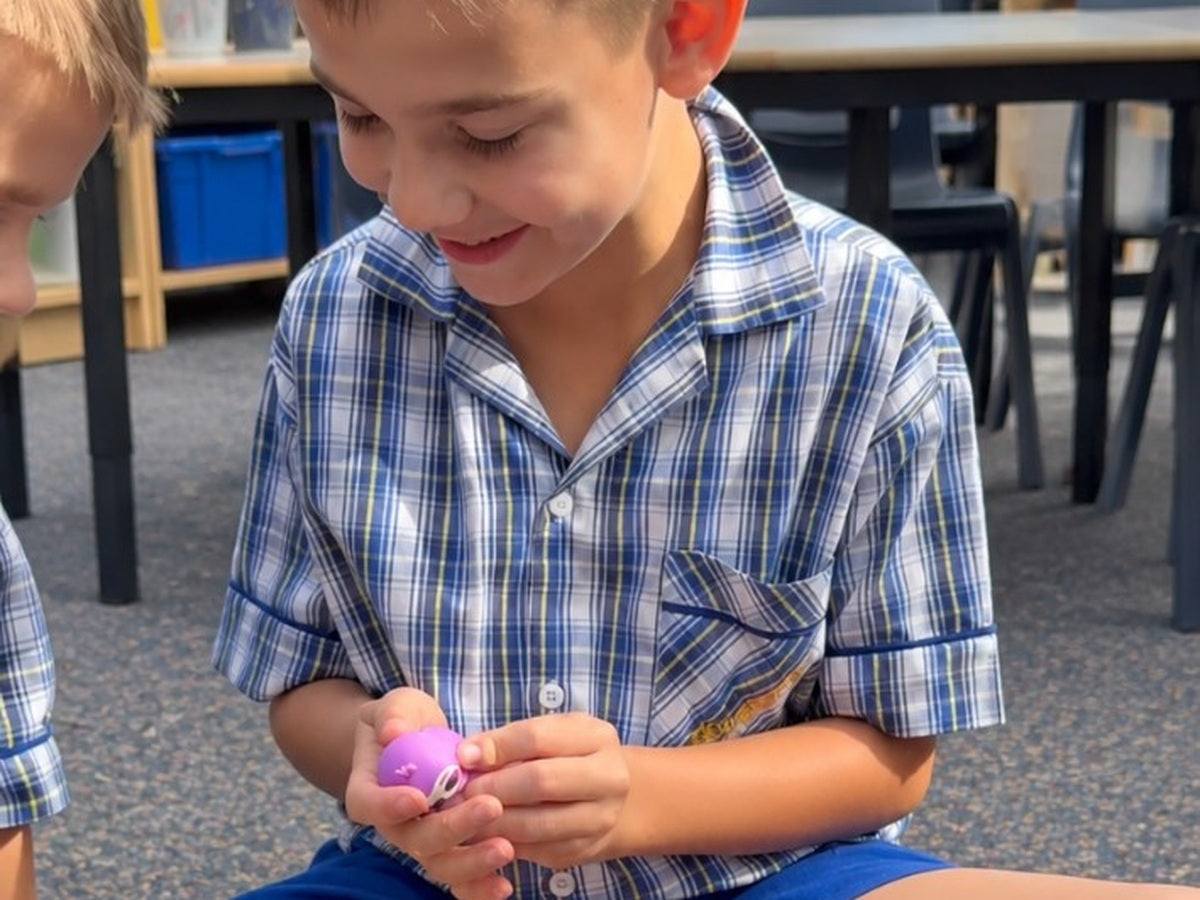
Some children chew their sleeves. Some pick at their fingers or nails. Others constantly fiddle with pencils, hair ties, clothing or whatever happens to be nearby.
Often, those little movements are doing a job.
Touch, movement and repetitive actions can give children something predictable to focus on when they're concentrating, waiting, navigating a new environment or dealing with big feelings.
That’s where sensory tools can be helpful.
But with so many sensory toys, fidgets and calming products available, it can be difficult to know what your child actually needs. And bigger, brighter and more stimulating isn't necessarily better.
What is a sensory tool?
A sensory tool is simply something that provides sensory input.
Depending on the child, that might involve touch, movement, pressure, sound or visual input. Some children actively seek particular sensations, while others can become overwhelmed by too much stimulation.
You might already notice your child naturally seeking sensory input without ever calling it that.
They may rub a soft blanket, squeeze something in their hand, swing their legs under the table, twist their hair, chew a pencil or repeatedly run their fingers over a particular texture.
The goal isn't necessarily to stop these behaviours. Instead, it can be helpful to understand what your child may be getting from them and whether there's a safe, practical alternative that meets the same need.
Different children need different things
There isn't one "best" sensory tool for every child.
One child might love squeezing something firmly in their hand. Another might prefer rubbing a textured surface with their thumb. Another may need movement rather than something to hold at all.
That's why it's worth watching your child before buying a drawer full of sensory products.
Ask yourself:
- What does my child naturally do with their hands?
- When do they seem to seek it most?
- Do they prefer something soft, firm, smooth or textured?
- Do they need movement or something tactile?
- Will they actually use the tool where they need it?
That last question matters more than we sometimes realise.
Think about where they'll use it
A sensory tool that works beautifully at home isn't necessarily practical in a classroom.
At school, children may benefit from something that is quiet, small and easy to use without distracting themselves or the children around them.
For some children, discretion matters too.
They don't necessarily want to pull out a large toy when they're sitting on the carpet, walking into school, completing their work or standing in assembly.
A small tactile tool can provide something for their hands to do without becoming the centre of attention.
Look for something simple
More features don't automatically make a better sensory tool.
Lights, noises, spinning pieces and lots of movement can be great fun, but sometimes the purpose isn't entertainment.
Sometimes a child simply needs something familiar to hold, squeeze or rub.
Simple tools can also be easier to incorporate into everyday routines because they don't require instructions, batteries or a particular activity.
They can simply be there when they're needed.
Let your child help choose
Children are much more likely to use something they genuinely like.
Colour, texture, size and even the character or appearance can matter.
Giving your child some choice also changes the conversation from:
"Here's something because you're struggling."
to:
"Which little tool would you like to take with you today?"
That small shift can help the tool feel like something that belongs to them rather than something being used to "fix" them.
What about fidget toys for school?
Fidget toys can be useful for some children, but it's worth remembering that a sensory tool and a toy don't always have exactly the same purpose.
If something becomes more interesting than the lesson, makes noise, rolls across the floor or attracts everyone else's attention, it may not be the best classroom option for that particular child.
For school, I tend to favour tools that are:
quiet, tactile, portable, simple and easy to use independently.
And of course, teachers may have their own classroom expectations, so it's always worth having a quick conversation with your child's teacher if you're unsure.
Where NIBSY fits
This was one of the ideas behind creating NIBSY.
After more than two decades working in education, I'd seen plenty of children who didn't necessarily need another big, exciting fidget.
Sometimes they just needed something little.
NIBSY is a tiny wearable companion designed to sit around a child's thumb. Children can hold it, gently squeeze it or rub the textured back with their finger.
Because it's small and quiet, it can travel with them — in the car, at school drop-off, during class, at assembly or anywhere they might appreciate having their little companion close by.
And each NIBSY has its own little superpower: comfort, bravery, confidence, positive thinking or friendship.
For a child, that can make it feel less like a "sensory product" and more like a little friend that's theirs.
The best sensory tool is the one that helps your child
You don't need the biggest sensory kit or a cupboard full of fidgets.
Start by watching your child.
Notice what they already seek out, when they seek it and what seems to help.
Then choose something that fits your child, their environment and the moments when they actually need it.
Sometimes the simplest tools are the easiest ones to keep close.